Teachers &
school staff
- See conditions in the spaces you use.
- Record the room, time and activity when you notice a concern.
- Share observations with your facilities team.


Indoor air quality for schools starts with clear information. Give your team monitoring, reporting and purification tools to act.
From one classroom to a whole district.

Part of Rhode Island’s HEAL Program.ThinkLite monitoring supports the state’s school air-quality initiative.
Better indoor air quality for schools takes teamwork. Give each person clear information to guide their next step.
Connect classroom air quality monitoring with clear reports and air purification where needed.

FLAIR IAQ
Flair continuously measures indoor conditions. Staff can check room conditions on the touchscreen, while facilities teams review connected data.
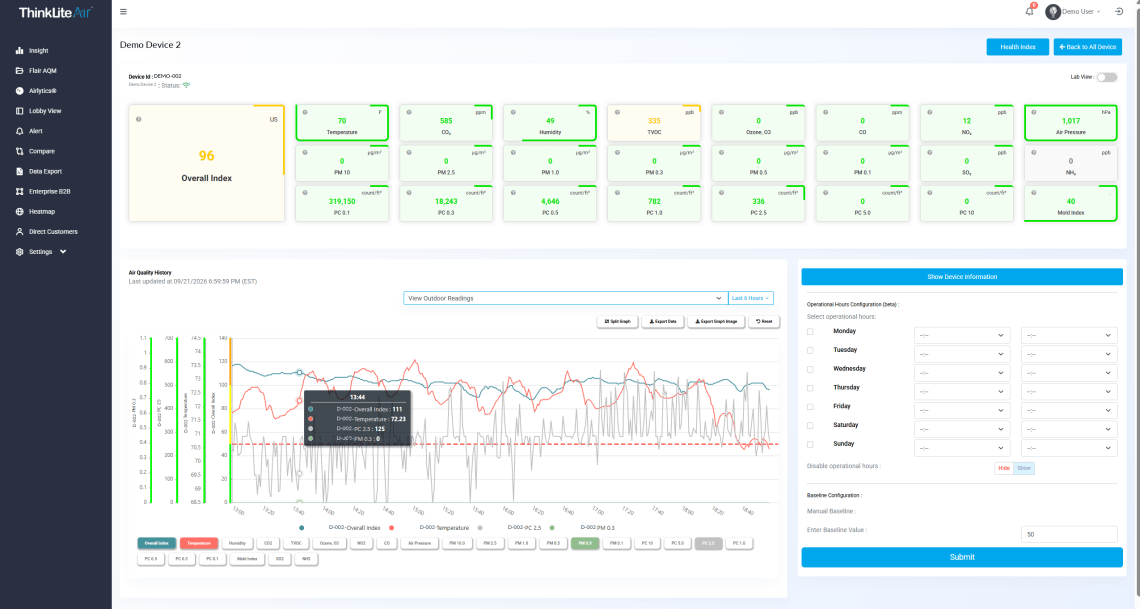
AIRLYTICS®
Airlytics brings current readings and historical trends into one dashboard. See what changed, where it changed and what needs follow-up.

THINKLITE HEALTH INDEX
Our work with Dr. Stephanie Taylor informs the Health Index. It adds health-oriented context to environmental readings.
Close the loop. Record the action, then compare similar school hours to check whether conditions improved.
Flair supports local building management system (BMS) connections through BACnet and Mod-bus, plus API and MQTT options. Review the readings with ventilation schedules, filter condition and maintenance records.
Explore demand-controlled ventilationASHRAE 62.1-2025 addresses ventilation and acceptable indoor air quality. For infectious-aerosol control, ASHRAE 241-2023 addresses equivalent clean airflow and building readiness.
RHODE ISLAND’S HEAL PROGRAM
Rhode Island’s Healthy Environments Advance Learning (HEAL) Program partnered with ThinkLite to install indoor air quality sensors in school districts.
HEAL pairs monitoring with building-system improvements and informed operations, connecting school data with the work each building needs.
Explore the HEAL story Rhode Island Department of EducationMeasure priority rooms during normal school activity.
Use the findings to focus inspections and maintenance.
Compare conditions and document the follow-up.
School air purification complements ventilation, source control and maintenance. Choose a standalone unit or a ceiling-integrated solution.

ICON M
Freestanding air purification for classrooms and shared spaces. Plan placement and capacity around the room’s size and use.
Explore ICON M
PURILUX
Air purification and LED lighting in one fixture. Integrate air cleaning above the classroom, leaving floor space for learning.
Explore PuriluxCLAAS · CLEAN AIR AS A SERVICE
Combine equipment, software and air-engineering support through ThinkLite’s leasing-based service model.
Talk to an expertBuild your CLAAS plan around three decisions:
Select priority rooms, monitoring and purification equipment.
Identify who reviews reports and coordinates follow-up.
Choose software, service and engineering support around your team.
Yes. Begin with priority rooms and a defined question, such as a recurring classroom concern. Establish normal conditions, assign a data owner and use the findings to plan your next phase.
Record the room, time and activity, then contact the school’s facilities team. Those observations help the team match concerns with air readings and investigate the building.
Use Airlytics reports to explain which rooms the team reviewed, when, what they found and what action followed. Then outline the next steps.
Flair records indoor conditions, and Airlytics helps your team review them. ICON and Purilux provide air purification alongside the school’s ventilation and maintenance plan. After taking action, continue monitoring to see how conditions change.
PLAN YOUR FIRST STEP
Tell us which rooms need attention and what your team wants to understand. We’ll help you plan the monitoring, reporting and purification approach.
© 2026 — ThinkLite. All Right Reserved.